
 OROKO CULTURAL ASSOCIATION
BERLIN - BRANDENBURG e.V
OROKO CULTURAL ASSOCIATION
BERLIN - BRANDENBURG e.V
History of Oroko Land
|
Oroko is an ethnic group made up of several clans. Each of the clans has its own However, the Oroko appellation prevailed since Ngrime didn’t have followers. When the political map of the South West province was later reshaped, the people found themselves occupying three
quarters (3/4) of both Ndian and Meme Division. These two divisions, of course, derived their names from Rivers Ndian and Meme respectively. It is worth mentioning that River Ndian traces the origin
of its name from the interaction between Nabangi and some Calabar fishermen occupying 3/4 of the above mentioned divisions, explains why Oroko is the largest tribe in the South West Province even
though both divisions are non-indigenous divisions. It is interesting to know that of the ten clans in this ethnic group, seven of the clans are found in Ndian division, two in Meme division and one
is sandwiched between Ndian and Meme. The largest of all is Mbonge clan with 43 villages. Although the Bakoko clan also has three villages, the Balondo Badiko clan is considered the smallest because
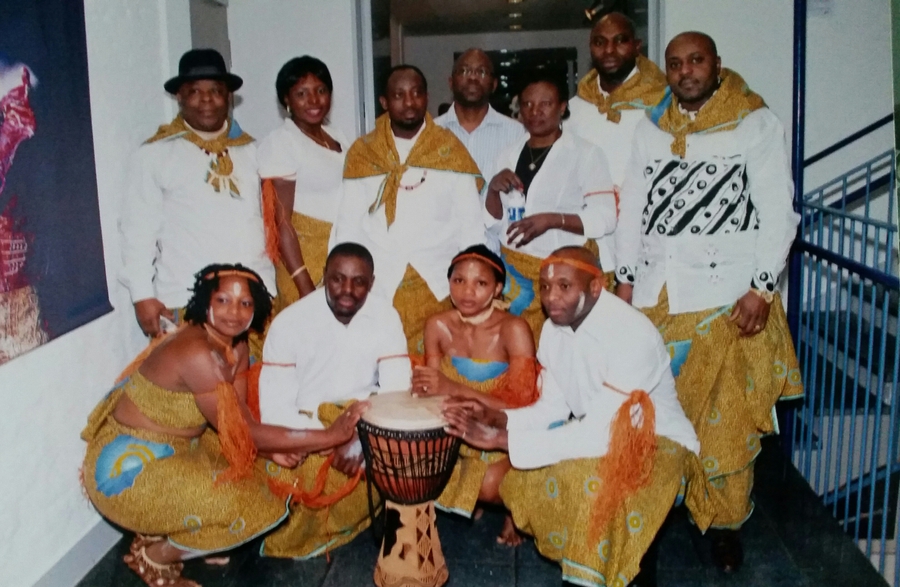
the three villages here are smaller in size than those of Bakoko. The Largest cosmopolitan village is Ekondo Titi and Dikome Balue is the largest indigenous village. The men dressed themselves in sanja (a loin cloth) wrapped around their waist in a masculine fashion over multicoloured jumpa regalia although today’s generation pretends to say the white long sleeve shirt has been the traditional wear. (See attached photo). The initiated juju men into the various traditional cults spice their traditional regalia with a nyariphu over their head. It is a tradition for the titled men in the etana (juju house) to greet each other by calling their titles e.g. Dior, Nfoni, Abwe Kenda etc. The women folk also have their own traditional and sacred hierarchy e.g Nyangeromo, Mosembe etc. However, the ``etana`` of the Oroko man does not extend membership to women. The`` etana`` was a powerful traditional "House of Parliament" without multiparty politics, where binding and peaceful decisions were arrived at. If there is one thing to acknowledge of this people besides their rich cultural background and natural intelligence, it is their sense of hospitality. This spirit of hospitality has now made them to look like the Achebe’s proverbial lunatics who may be outnumbered even though they own the place.
|
Several years ago in the Oroko regions, messages were transmitted from one village to another by the beating of wooden drums, - the "Elimbi". The neighboring villages interpreted the rhythms from these drums to obtain the messages and responded accordingly. Later on, a messenger was dispatched carrying a "Desungu", - ( a special stick tied like a bundle with special leaves ) to the next village. From the look at the special bundle, the village elders interpreted and understood the messages and responded accordingly. Specifically, when a chief had a message for his villagers, this messenger would run around the village ringing a bell and relating the message to the villagers. This person was called the "Town Crier".
In most of the villages within the Orokos, women and children bear the burden of supplying their families with water from streams and ponds. They do this by walking for miles with heavy water containers on their heads. In spite of the effort by these children and women, the water is drawn from very contaminated sources thereby predisposing them and their families to several water-borne diseases.
Statistics show that over 40 children die every day from a deadly combination of water-borne diseases like typhoid and cholera, and severe cases of malaria. Our goal of providing drinkable sources of water to the several strongly affected communities requires enormous financial input that may take more than a decade to reach the goal of good portable water for all in the Orokoland.
find us
Oroko Cultural Association
Dominicusstr. 42
10827 Berlin
 Teilen
 Druckversion